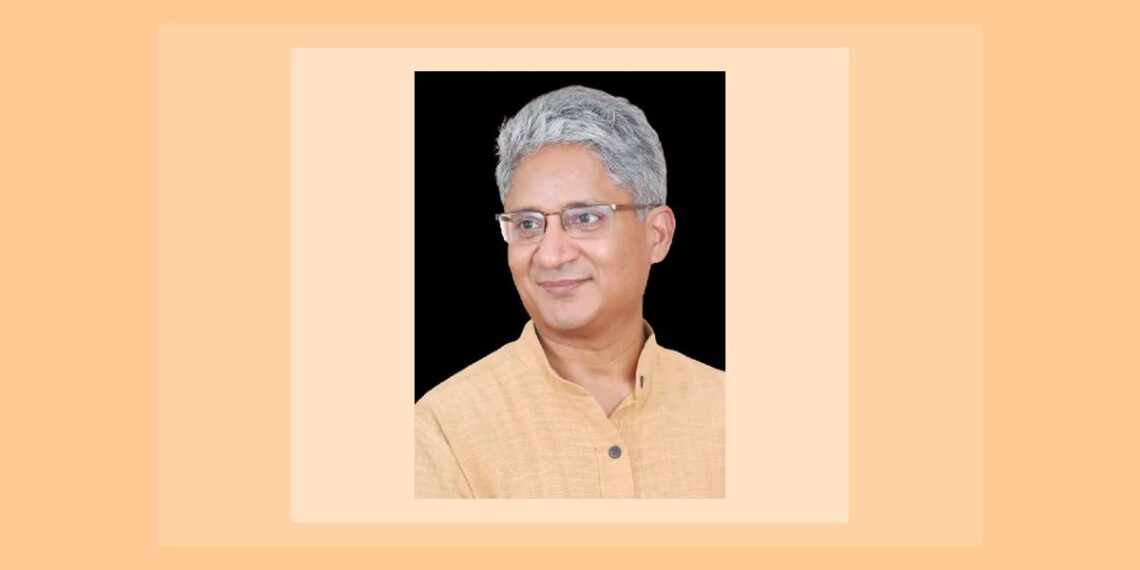

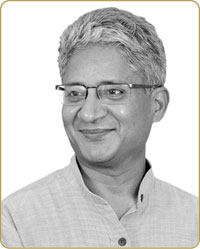
 MB: Dear Friends, today we have with us, Dr. Rajan Sankaran, one of the most well-known homeopaths in our homeopathic world. A person, who has inspired many and has also been the center of many philosophical debates pertaining to the practice of homeopathy, he is here with us today to share more about himself, his approach and work.
Dr. Sankaran, welcome to the Hpathy Hot-Seat!
MB: It has been nearly 16 years since you published ‘The Spirit of Homeopathy’. What changes you have perceived in your own understanding of homeopathy in these years?
RS: I’ve been in practice for a little over 25 years so far. Right through, it has been a search to find a method that gives consistent results. I found that fundamental to finding such a method was to clearly perceive what is health, and what is disease. If this understanding is not clear, then we don’t know what we are treating. The basic concepts are not there.
As time passed, the basic concepts became clearer to me. Each step has made the results more consistent. Along the way, I developed three systems: Kingdoms, Miasms and Levels of Experience.
Now practice has become simpler. But to reach this stage of simplicity, one crosses many different levels. I would like to share with you, through illustrative cases, some parts of my journey.
Case 1
1986: This is one of the earlier cases that I saw, and recorded on video. The man, 58 years old, had had a heart attack. He also had hypertension and diabetic ulcers. Particularly, there was a very large ulcer covering most of the dorsum of one foot, and he had been advised to get the foot amputated. But given his history, the operation was a high-risk one, so surgery was ruled out. He therefore had few options. The bones of his foot (metatarsals) had undergone osteolysis and had dissolved.
He was an Income Tax officer. He was known for being responsible and upright and had shown exemplary honesty and dedication. Apparently, even his bosses were somewhat afraid of him, because of his uprightness and high sense of responsibility.
His first heart attack came about thus. He had conducted a search-and-seizure operation, and found some papers incriminating the party concerned. He stored the papers in his office drawer. The next day, they were missing! He felt that his own reputation was at stake, and was extremely concerned that it should not be stained. As a result, he moved heaven and earth to get those papers back, and finally did! But on the evening of that day, he got the heart attack.
Having gleaned this background information, I gave him Aurum metallicum 200. He showed much improvement in his general health and the ulcer. After about two months on the remedy, an X-Ray of the affected foot was repeated. The bones that had dissolved re-appeared!
Case 2
This 72 year old male patient came with the diagnosis of Lyme disease. He is a Catholic priest, traveling a great deal, over countries, teaching N.L.P. He had been living in India for about 50 years, giving these seminars, and moving from one place to another.
He explained how he kept moving, staying for about two weeks to a month in one place, then back again to his retreat house for about two weeks, and then going somewhere else. Four months within the U.S.A., then two weeks in Ireland, then back again. Each time he goes to a new group of people, prepares his talk for about two days and then gives the seminar. He enjoys giving the seminar. Then again he moves to the next place. He knows a great deal of people in all these places, so that in many places he meets people that he’s known. About 50 people signed up for his seminar in Mumbai, maybe six of them would be repeats, the rest would be new. He says, in the beginning of the seminar, he’s not always sure, but it always turns out well. He looks forward to meeting new people and moving about.
In the seventies, he started doing group work. But he felt that it was “physiologically tight”, that he wouldn’t be “free”. “My face would become tight, and my movement tight,” he said, “Once I started to work, that would release and become less and less. I felt a sense of tightness. I wouldn’t use gestures and move around as freely as I would want.”
While listening to his story, it became apparent, that the moving and the meeting new people, which were both important to him, were aspects of the same thing. Even when describing his seminars, he talked of the movement; didn’t talk of his capability or the subject itself. He talked of the meeting of new people, which again is an important aspect of his sensitivity. The fact that he spontaneously mentioned it, repeatedly and in different ways, indicated that it was his sensitivity.
When he described how group work made him feel tight, here I realized that tightness is the opposite of movement.
When I asked him what ‘tight’ felt like, he said, “Tight feels like holding back, lack of movement.” When I asked, “What comes to your mind with tightness?” He replied “I don’t have freedom in my face, a stiff face and I don’t move.”
He got Rhus toxicodendron.
This case demonstrated how, when you come to the core, everything comes back to the same thing. Ask a question on something, it’s another path back to the core.
Usually, with homoeopathy, we think of symptoms such as “Feels anxiety about performance” and then we think of Argentum, Medorrhinum, Lycopodium, Silicea But if we merely go on these types of symptoms, we could make huge mistakes. We have to go behind such apparent symptoms to the real symptoms, which are the sensations underlying the experience of the symptoms.
This man’s case is not about performance; it is about tightness and movement. When you can see this, and bring the case down to that level, it is simple.
Here are some excerpts from the follow-ups:
He said, “I am feeling better. People tell me I look younger. My back has stabilized. I still exercise in the morning and walk in the afternoon. I feel very comfortable with this. Recently there has been a bit of congestion in the chest. Mind and mood have been very good. I have increased my personal prayer to two to three hours of meditation, vipasana. I feel much more peaceful, and relaxed. I am comfortable in the day.”
“I used to worry about the future; if a seminar was coming up, that I would make mistakes, won’t succeed, and others won’t like me. But now I don’t worry about the future, I feel much more easy and know it will be all right. I have a seminar coming up on Tuesday morning, and have no worries about it. Anxiety always used to be there. Even now I have a little, but not where like it used to be.”
“There was maybe a tightness inside. Now it’s maybe there, but much less. Maybe about 60% reduced.”
“There’s a change in my attitude towards life. I don’t set any goal, like I have to succeed, or be the first.”(Here, he is describing health; the ability to be in the moment without compulsion. Also an awareness; a looking inward. There is a decrease of your own state. It does not have the power on you that it had. That is how you have the ability to be in the moment.)
“I just see whatever happens when it happens.” (This is what we should see in our patients).
“If I fail, it doesn’t bother me. I feel easy with what’s coming up. Lately I say, I’m becoming a hermit. I prefer to be at home. They probably think I’m a bit strange. I don’t move around like ordinary people. I stay at home. I don’t go out to restaurants or movies or to meet people. I used to do it, and didn’t like it. I prefer to be studying or reading at home. As for the work, I still travel, and like going from one place to another. When I get there, I am prepared. I just go in and do the work. Moving is a part of doing the work.”
“I feel like a young person again. I’m smiling.”
Lyme disease was gone. The lab reports were all negative.
Case 3
A child came with recurrent multiple boils on both lower limbs. He would take antibiotics, but shortly would develop them again. So they brought him for homoeopathy. At the first visit he had fever. He wouldn’t sit down in one place and moved about constantly. He had with him three brightly coloured papers, folded into little airplanes. He was constantly playing with these. He would put one on the table, and the other one would attack it. He kept doing this continuously. So I asked him to tell me about the papers.
He said, “The red one is me. The other two are enemies. The others will die and I won’t.”
The boy narrated a dream of a black witch with a net like a fish net. She trapped him and his friends and started hitting them. He woke from the dream with fear.
When I asked the mother to describe him, she said, “He is very active and restless, and hits people. He beats the maidservant in the house. He always hits her behind my back, the moment I am not around.” The maidservant said that he jumps on her from behind and brings her down, then hits her.
I gave him Tarentula.
He responded within days and remains well, five years later. Two weeks after the first dose he had a dream again, in which he trapped a ghost and locked the door. Previously, someone else had trapped him. The dreams had changed.
* * *
It took more than a decade of practice to see that there are essential differences in patients belonging to the three different Kingdoms.
The first case was a mineral case. It was about performance, ability and the need to maintain a position. The second one was a plant case, which exhibited, at the depth, a sensation and its opposite. Tightness versus movement. And in the third case, an animal case, there is the theme of one versus the other. You are doing it to me, I am doing it to you. Victim and aggressor.
In Minerals, it is about structure; what I have and don’t have, what I will lose. It’s about the completeness or incompleteness of oneself. Am I losing my completeness? The problem is with the self. In the Periodic table of elements, minerals are placed in rows and columns according to their atomic configurations, and interestingly, these rows and columns seem to share common characteristics. Each row represents a particular stage of development of the human being. For example, the first row is the stage of conception, the second of fetal life and labor, the third of infancy, the fourth of security and work, the fifth row has issues with creativity and performance and the sixth of responsibility. The Aurum case mentioned earlier is from the sixth row.
With Plants, it is all about sensitivity and reactivity. Each family of plants has its own type of sensation and its opposite. For example Anacardiaceae ( of which Rhus tox is one ) has the sensation of stiffness and the opposite, namely movement. Within the family, the plants may be differentiated by each one’s miasm.
The Animal problem is “between me and someone else”. It’s the issue of the survival of the fittest. It’s about competition, high and low; even “me versus myself”. Attractiveness. Animal are further divided into classes and subclasses like insects, birds, reptiles , mammals etc, each with its specific survival mode.
* * *
At some point, it also became clear to me that there are differences in the depth and pace of each state. They are characteristic of different types of responses. And these responses correspond to the body’s response to a specific type of infection. I called the specific type of response “Miasm“, which corresponds to the way in which the organism responds to a specific type of infection. I could identify ten miasms, namely Acute, Typhoid, Psora, Malaria, Ringworm, Sycosis, Tubercular, Cancer, Leprous and Syphilis. This system helps to pinpoint a remedy more particularly.
Let me clarify my perception of the miasm in each of the above three cases.
The Aurum case had great desperation and a sense of hopelessness. He had to move heaven and earth to get the problem solved. His life was very difficult and there was too much responsibility in it. The miasm here is syphilitic.
In the Rhus tox case, everything came and went. They were crises that blew over. It’s the typhoid miasm.
The Tarentula boy was fast paced, moving all the time. The miasm was tubercular.
* * *
The Third system I worked with is the Levels of Experience. I found that there are seven levels in which we experience reality or perceive the case.
Level 1: Name: pathology
Level 2: Fact: symptoms
Level 3: Feeling: emotions
Level 4: Delusion
Level 5: Sensation
Level 6: Energy
Level 7: Seventh
We can perceive any given situation at any level.
For example, some time ago, I had a problem with a visa. I had to get one to a particular country. The consulate was very inefficient and didn’t give my visa on time. Time was getting shorter and shorter. I called up the vice consul. He assured me that the visa was in his hands, and asked me to send someone to pick it up. I sent someone; they made him wait for six hours, and told him to come the next day. I called again, and they asked me to send someone again. Again he waited six hours and was told to come the next day. I yet called again, and they told me it was ready. The person went to pick it up, but was told that it would take three days to process. Finally, just the day before I left, I got my passport.
What was my experience of this?
The fact was that I didn’t have a visa and I needed it. My mind was thinking of facts. Then emotions came – anger and anxiety. Then physical symptoms of palpitations. I started thinking, “Why is this happening? Why are they doing this?” I then thought that there was a conspiracy, they were trying to harass or persecute me.( I was working on the Snake Family at that time.) That was my delusion.
So on one level, there was the fact. On another, the emotion. On yet another, a delusion. If it was a conspiracy, what should I do? Write about it in the newspaper?
I felt something in the abdomen and throat; a very intense sort of symptom, something like choking. I can only describe it with sounds and gestures, since words are inadequate. It had nothing to do with the delusions, emotions or facts.
It felt very familiar. I might have experienced it earlier when I had an exam or a fight with someone. A consistent experience that is physical as well as mental, deeper than the body or the mind, so that it needs sounds and gestures to express it. It has been constantly in the background since birth. It has nothing to do with the outside, actually. It surfaces from time to time. It is the sensation.
We have to take the case-taking to that level. It is the experience of the human being.
Once you get to that level, how do you use it?
Ask the patient to describe it.
Let us consider that he says, “Something is coming and crushing me” (In Animals, something is doing it to me). Or he says, “Something is contracting and expanding” (This is Plant). Or he says, “My whole structure has been compressed and wants to explode.” (This is Mineral). If you come to this level, the patient could even tell you the name of the remedy!
When you have a perception of the seven levels, life becomes interesting. It’s your unique experience; you’ve carried it from your birth and will carry it to your tomb, unless you take a homoeopathic remedy that dilutes it. You can only understand it from the level of experience, not the mind. Because the Sensation does not follow the intellectual logic we school ourselves with. It doesn’t “make sense” at all; it is total nonsense. But, yet, it is an undeniable truth.
The truth is your experience, your sensation.
We also look for nonsense, when we look for the level of experience. At the Emotion level, expressions begin on the face. Then usually, his eyebrows will rise when he starts imagining; for example, “This boss of mine is a dictator who specializes in making us feel so little.” When he gives images, for example, from human history, such as of Hitler, or books or movies, universal symbols and archetypes, he’s still at a human level. When it goes beyond that…it doesn’t make sense. We usually don’t want to talk about it or even experience it, because it makes no sense at all.
Imagine, if you would, a 45-year-old man, making paper planes and attacking one with the other, you would certainly commit him. So he pushes it down and suppresses it. “I won’t allow myself to feel it”, so he develops a physical pathology with the same sensation, and it becomes a disease with a scientific label, such as migraine, asthma or allergic bronchitis. The doctor thinks he is a sane person.
He could say, “The headache is killing me”, but if he did the paper-planes-attacking thing…
The more superficial the level of experience of the patient, the harder it is to get to the sensation. The more you live in the sensation level, become aware of your innermost experience and not push it down… just be aware, not act on it of course, especially if it is something like wanting to choke and kill someone…it will spare you a lot of physical pathology.
So the “nonsense” part is a plant, a mineral or an animal. Each of us carries one inside. You need to find what is speaking inside. You will start hearing that language in everyday life and inside of you.
Nowadays, I hear almost nothing else!
In case taking, we could hear facts, emotions and stories. We sometimes get lost in stories. We need to go behind the story. Take the non-human specific word, or the gesture, and if we make the patient focus on that, it helps him go beyond.
For example a patient (a 26 year old female) came with eating disorder since 8 years. When asked about it she said it blocks her life. Before she could go further to describe the disorder, I asked her to describe “it blocks my life”. From here she said it was like a glass wall between her and the world. I asked her to describe the glass wall. And then we could go straight to her core sensation of being closed and oppressed as opposed to open and free. She got Cannabis indica as the remedy.
The inner song expresses itself through gestures and non-human specific words in everyday conversations. It opens a secret door, and we explore a completely different world. In that world, we hear the source, the remedy speaking directly to us, as it were. Then we can be sure of what it is.
Homeopathy has become system based instead of only symptom based.
And the results are gratifying.
MB: Dr. Sankaran, there are many questions that arise from this explanation. I will put them forward one by one.
You have said –
In the Periodic table of elements, minerals are placed in rows and columns according to their atomic configurations, and interestingly, these rows and columns seem to share common characteristics. Each row represents a particular stage of development of the human being. For example, the first row is the stage of conception, the second of fetal life and labor, the third of infancy, the fourth of security and work, the fifth row has issues with creativity and performance and the sixth of responsibility.
Do you know that the arrangement of elements in the ‘rows and columns’ is not absolute. There are many problem areas with the Mendelev’s periodic table and scientists have proposed many new layouts like long, spherical, cyclical and helix arrangements. Check this site for complete details –
http://www.meta-synthesis.com/webbook/35_pt/pt.html
My question is when the rows and columns are themselves arbitrary, how can you fix stages of human development, emotions and problems to them?
RS: The simple reason is that these rows and columns and the pattern can be consistently seen in the past successful cases in practice, in the provings of the remedies and in the application of these concepts in new cases.
MB: You said:
“you’ve carried it from your birth and will carry it to your tomb, unless you take a homoeopathic remedy that dilutes it“
Can you please elaborate this? Does the ‘sensation’ (which is not healthy) never go – even after the simillimum is administered? Is it only weakened (diluted)? How can we call it a ‘cure’ then?
RS: The ideal of cure is rapid, gentle and permanent removal of the disturbance of the vital force. However as in any ideal, we can only go towards it more and more. Whether we can reach it is a moot point.
MB: Your concept of Miasms is very different from what Hahnemann had proposed. Why do you still prefer to call your concept “Miasm’? Why not some other name? Don’t you think it creates more confusion about an already confusing concept?
RS: I believe that they are the same idea looked at from two points of view. You can look at a miasm as an etiology like Hahnemann did, or look at it from the phenomenological point as I do. In practice it amounts to the same thing.
MB: Dr. Sankaran, Hahnemann gave three miasms; J. H. Allen added the fourth one, after which others have added/proposed Cancer, Typhoid, Ringworm, Chickenpox, Malaria and Leprosy etc. according to their own understanding. Miasms have been called a predisposition, genetic susceptibility, suppressed and maltreated infections, a sin, reaction to a situation and what not! Where do you see the meeting point? What is a miasm? Do you think the homeopathic community will ever reach a consensus as to what are miasms?
RS: Chicken pox is not one of the miasms on my list. The rest are. I think confusion arises as long as you are on one path in the mountain, when you reach the top you see no differences. Similarly, all these various concepts of miasma are basically saying the same thing i.e. they are a classification of states of being or disease. Such a classification is handy in locating the remedy, it does not matter what the theory behind the classification is. Whatever the school you follow, a syphilitic miasm is one that is destructive in mind and body. The psoric is more functional and the sycotic more of overgrowth and fixed. So there is already a meeting point notwithstanding the differences in theories. The rest will also follow soon.
MB: The opponents of the classification methods say that nature did not create classes; it is the humans that have done the classification to improve their own understanding of the life forms on earth. So identifying remedy actions in relation to their kingdom and genus is ‘synthetic’. Your take on that?
RS: Nature is varied, and surely there are plants minerals and animals, whether humans have named them so or not. Each type has its distinct features and if we accept that our remedies come from these sources, we must be able to see the differences in the remedies from the three different sources.
MB: The last set of answers came back very quickly. If ‘speed’ is an animal character, then your remedy should fall into the Animal Kingdom! Have you ever tried to analyze to which kingdom and genus, your own remedy belongs?
RS: Speed in not specifically animal, it is only a quality. To know the kingdom and the genus, it is not enough to know one quality; one has to perceive the whole pattern. This is not superficial, there is an in depth experimental inquiry that is called for that needs to go into the Sensation level. One does not analyze a kingdom of someone, least of all his own. One goes into the experience and uncovers what comes up. It is not mathematical or logical, it is a bit like archeology, we need to uncover what lies beneath and then it will reveal itself to us.
It is not easy to take one’s own case. I did take help of colleagues in finding a remedy which helped me.
MB: What is the ‘Seventh’ level?
RS: The Seventh level is the continuum. It is that part of you that is there from birth to death. On this continuum energy patterns, various delusions, and various pathologies play. It is constant, continuous and equal at all times. The other levels rise and fall.
The sickness is the energy pattern that is imprinted on you. Beyond that there is no sickness. The Seventh level is the part that is not sick. It is the bare slate on which the pattern of sickness is written. It is the state of hypnosis, meditation or coma or very deep sleep, which is beyond the six levels of experience. Where the person is blank, silent and is able to observe and narrate the other levels.
In case taking the person has to go back to the level which is not sick, in order to observe the sickness. He has to go to a level which is continuous and which has not changed in order to observe what is changing. He has to go to a level that has been there throughout, from birth to the present moment, so that he can describe the whole experience. Therefore the Seventh level is the most important level for healing. If this level didn’t exist there would be no way a person could describe his turmoil and find the healing agent.
During the case taking process, the homoeopath can be likened to a blind man who is accompanying the patient on a trek. Neither of them knows where the path is leading. The homoeopath encourages the patient to keep on the path and describe to him in great detail what he can see on the way. When the path ends, the homoeopath lets the patient describe exactly where they have arrived.
This metaphor is interesting because it dissociates both the patient and the homoeopath from the path and the destination. It is as if the path and the destination belong to neither and is examined by both as objective reality separate from the observer. The only difference is that the patient can see it and the homoeopath depends upon the patient’s description. The homoeopath encourages this process and sees that the patient does not wander off the path.
In effect, it means that the sensation (source) is something that the patient needs to separate from himself in order to watch and describe it as a phenomenon in itself, just as he would describe the scenery to a blind man.
Incidentally, the physician also has to go into his Seventh level to take the case. Then only can he be an unprejudiced observer.
I picture two women sitting on a park bench, with each of their children playing in the park, the women talking to each other about their respective child. The child is the woman’s child, but still separate from the woman, and each woman can observe and describe her child to the other.
If we think of our state as our child, it is ours, yet separate from us, then we can describe its antics from the position of an observer and at this level we can find common ground with the rest of humanity.
When we interact with someone else, we are often only interacting with ourselves. There is no real dialogue. Two people are talking to themselves rather than to each other. We come from such completely different worlds, each of us, that we cannot even begin to comprehend what the other is experiencing…except when we take a case, when we are observing without prejudice, at the seventh level.
In the process of watching, you interact less, you observe more. You listen to the other one’s inner language and address it. You see the states each one is stuck in and you don’t blame. So there is often no anger, no fighting, and no acrimony, just watching and being. It is calming in a major way.
I believe that the only permanent and peaceful connection that one can have with another one is at the Seventh Level. Any connection we have with each other at fact, feeling, delusion or sensation level is conditional to that fact, feeling, delusion, or sensation being there. These are not permanent. The only non-changing thing in the Human is the witness, who is beyond the six levels and observes it as a neutral observer. At this level, we are beyond our diseased states, our sensations and delusions. We are at a similar level to other beings that are looking from the Seventh level, though what each one is looking at will be different. Yet the process of observing is common ground, which we can share with each other.
Then we come to the common point of all humans, namely the silent witness, where there is acceptance of the self and the other as is, and also there is the being in the Now. This is true friendship, or oneness.
MB: Isn’t this concept similar to the ‘Self-Actualization’ that we study in Psychology or the ‘Nirvana’ of the Indian philosophy? Why would a person need a remedy if he can reach the ‘Seventh level’? To reach such a state of mind, wouldn’t a person need to be healthy first?
RS: This is not a concept, it is a simple observation. If you need to describe your, physical, emotional, delusion, and sensation levels, then you temporarily need to be a level which precedes these, which is the background. This is the Seventh. In case taking we can take the patient to this level by simply making him a witness of his experience, we put him in a witness mode for the moment. This is possible to do in most cases. One does not have to come with a deeply introspective mind to get into this level for a short time. However, one cannot remain in this level all the time. One reverts back to his original level after the case taking, be it emotion level or delusion level etc.
Whether this is similar to Self actualization or Nirvana, I have no idea since I know neither of these. I simply say what I have seen and what I do.
MB: You said somewhere that your results have quadrupled over these years – previously it was 1% and now it’s 4%!! But seriously, have you ever quantified your results at various stages/levels (the stage when you were working on delusions, then sensations, then energy; the development of the kingdom classification and the extended concept of miasms) or is the assessment of increased ‘gratification‘ subjective?
RS: No, I have not quantified my results in assessing my gratification. I have been as objective as possible.
MB: Your father was a very famous and eminent homeopath. What has been his influence in making you the homeopath that you are?
RS: My father continues to be my inspiration. Not only did he give me the fundamentals of homeopathy, but also my very core approach to life, to work, to thinking, to research and to excel.
He taught me that the greatest joy is in doing one’s work to the best of one’s capacity and to stretch one’s arms towards perfection. He taught me to be open, non-judgmental and to continue to research and develop. He taught me to let knowledge come to us from all sides. He gave me the ethics and values which I now uphold. Besides, he loved me and had confidence in me, and this made a lot of difference.
His teachings and booklets on various subjects in Homeopathy have been my building blocks. I later put them together in 2 volumes called, The Elements of Homoeopathy.
His practice and his cases gave me the faith and confidence in Homeopathy from a very early age.
MB: Apart from you own father, you were blessed to have some of the best and most experienced homeopaths in India as your teachers – Dr. Phatak, Dr. Kanjilal, Dr. Sarabhai, Dr. B.N. Chakravarty, Dr. Koppikar. Can you tell what you learned from each of them and how each one of them contributed towards your evolution as a homeopath?
RS: All of these masters were steeped in classical homeopathy, it was in their very bones. Just to be near them was enough to influence anyone. Each looked at it in a slightly different way. Dr Phatak was adept in the methods of Boger, of Grand generalization, and had a very artistic way with coining and using rubrics. Dr Kanjilal was like a father to me. He faithfully followed hahnemannian homeopathy, and worked diligently on his cases. Dr Sarabhai used high potencies frequently repeated; Dr Chakravarti had an amazing number of cured cases of the most difficult conditions including cancers. Dr Koppikar still continues to encourage me with his kindness and deeply inquiring mind.
MB: Did any of them ever feel that you would become a homeopathic prodigy some day?
RS: They were all fond of me, and were happy at my progress. They encouraged me each step of the way and whatever success I have I owe to them.
MB: What did you find lacking in the practice of all these great people that led you to explore new territories?
RS: Each one has to understand the truth in his own way. They did in their way, nothing was lacking. I did in mine. The exploration of new territories has always been motivated by an intense desire to find a method that produces consistent results in practice and a method that can be duplicated by others.
MB: What were your initial days of clinical practice like? Did you inherit your father’s busy practice or did you create your own niche from scratch?
RS: I graduated 2 years after my father passed away. When I came into the practice, there were no patients. But I did have the goodwill. I knew I had to do what I could. Right from the beginning I never compromised on principles in order to please patients. I did what I believed was correct. This helped a lot in building of my reputation. In the beginning I was a one man office, receptionist, compounder, doctor, all in one. However, in a couple of years I could build a good practice. I worked hard; I had 14 hour work days for over 20 years. And at nights I would read material medica with colleagues. Sometimes meetings would last all night. We were young and very enthusiastic.
MB: Although you were taught by some of the best classical homeopaths in India, I assume, like all of us, you have had your own moments of uncertainties in the beginning of your practice. Was there a time when you experimented with more than one medicine at one time, or using combination remedies or the very common practice in India of using Biochemic Medicines and Mother Tinctures along with the remedy selected on the basis of symptom similarity?
RS: I have not experimented so far, though it is possible I might do it in future. The reason I did not experiment with other methods is that I was trying to perfect one method. When one wants to perfect one way, he needs to close all other doors so that he can focus and improve on his chosen method. That is also the reason I did not use other therapies like psychotherapy, acupuncture, Bach remedies, etc in combination.
MB: 16 years and more than 10 books- all focusing on understanding the case, case taking, analysis and materia medica. Why there is still no book from you that deals with case management, potency selection, repetition and everything that needs to be done to take a case to the curative stage – after the remedy has been administered?
RS: As you can understand, there is no management if there is no right remedy. So all my efforts so far have been focused on how to get more consistently to the right remedy. This has taken up all my time and energy. Only recently, I have come to a comprehensive system and could focus on writing on the aspects you mention. My latest book, Sensation Refined, focuses, besides other things, on Potency, Repetition, Acute conditions in chronic cases, etc.
MB: Now that prompts me to ask you some more practical question.
First. Although potency selection is not a straightforward issue we all have some basic algorithms/wire-frames in our mind that help us decide the potency for a given case quickly enough. How do you select the potency for a given case? What thought process goes on in your mind when the time comes to decide the potency?
RS: I decide the potency by the level of the patient.
It is important to know if the person is feeling the sensation locally or generally. Often the sensation is the same, but the level at which they experience it in their everyday lives determines the potency. When the sensation is general, it is common to mind and body, and it comes up in all circumstances.
Normally, in the process of case-taking, we are able to reach sensation level with the patient. However, he or she may not be living at this level in everyday life. The potency is selected according to the level that is experienced daily by the patient.
LEVEL 1: NAME: STRUCTURAL PATHOLOGY: 6C
Prominently seen: Here the symptoms of the pathology are the only ones available, and completely dominate the picture. For example, oedema in heart failure, breathlessness in lung fibrosis, severe joint pains in osteo-arthritis, paralysis in multiple sclerosis.
Stage of Pathology: There is structural pathology.
Modalities: There are no characteristic symptoms or modalities locally and generally. The modalities that exist are primarily related to the pathology. For example, a case of cancer of the oesophagus will have aggravation on swallowing.
Degree of characteristics: Emotions: Emotions, if any, are related to the pathology, are common, and not individual.
Delusions: In the present moment, they will not be there, but on enquiry you may find that there may have been delusions and dreams in the very distant past.
Hand gestures: will not be prominent or readily available. One will have to use bypasses to get to the sensation level where hand gestures are seen.
Perception: It’s not me, but the part that has the problem. The whole is not involved. The word “I” isn’t there. “The disease is something else sitting on me.”
“THERE IS …” a tumour in my stomach.
For example, if somebody’s house developed a big crack in the roof, he would
say, “There is a crack in the roof.” He sees the problem as local, structural, and not really belonging to him.
LEVEL 2: FACT: 30C
Prominently seen: Here, the local symptoms and local modalities are more
prominent.
Stage of Pathology: Structural pathology is often found locally.
Modalities: The modalities affect the locals and not the generals.
Degree of Characteristics: The modalities could be characteristic. The nature of the problem itself could be characteristic, but generals are not prominent.
The patient gives most importance to local complaints and it is difficult for him to talk about emotions and delusions.
These levels seem to be well compensated and one has to dig deep into his past to elicit the state that preceded that localization.
Emotions and Delusions: Dreams, emotional modalities, general modalities, cravings, etc are often very minimal.
Hand gestures: Few or absent.
Perception: “There is a problem with something that belongs to me.” Or “I have a problem in this particular area of my life.” The patient will define the nature of the problem, which will be characteristic.
“I HAVE …joint pain, or burning in the stomach.”
For example, I have a joint pain. < First motion, climbing, > Continued motion.
Q: What effect does this problem have on you?
A: No effect.
Given Calc fluor 30.
When you are planning to build a house, and can’t see eye to eye with the architect about it, you could say, “I have a problem with my architect. He is very fixed in his ideas.” The problem is seen locally in a part that belongs to you. For other examples, “I have a rude boss.” Or “I have inefficient staff.”
LEVEL 3: EMOTION: 200C
Prominently seen: Here there is equal prominence of generals and locals.
There is a good flow, or interrelation, between generals and particulars; i.e. one leads to the other. For example, headache from anxiety. The local affects the general, and general affects the local.
The chief complaint is excited by a circumstance, which is usually present.
The present position aggravates. He will say, “Each time there is a situation I am sensitive to, I am affected. If it is not there, I am not affected.”
Stage of Pathology: The main complaints are usually functional.
Modalities: The local symptoms have general modalities. For example, headache worse from anger.
Degree of characteristics:
Emotions: The patient is sensitive at the emotional level, and takes things emotionally. “I am affected by it.” For example, “Each time the patient comes late, I get really irritated.”
Delusions:
Hand gestures:
Perception: “I have a problem that affects me.” He sees the problem not affecting the part but affecting him. Even if the problem is local, the affect on him is general.
“I FEEL…”
For examples: “I feel depressed by the situation.” Or “I am irritated by the headache.”
LEVEL 4: DELUSION: 1M
Prominently seen: The symptoms of the whole being are prominent; the whole person is affected. The disturbance is significant along the PNEI (Psycho-neuro-endocrino-immunological) axis. The complaints are usually general, either intensely mental, or hormonal. For examples, intense fears, or obesity.
Dreams, interests and hobbies are prominent.
For example, a Calcarea carb child with strong craving for eggs, with strong sweating on the scalp. He has strong fears and nightmares, seeing ghosts at night. His complaints are obesity and a tendency to catch cold. There is disturbance along the PNEI axis and he lives out his sense of insecurity. He says, “I sweat,” “I crave…,” and if he could express it that way, he would say, “I am a very insecure child. I need a lot of protection.” It is the whole being in a particular situation.
The state is more or less continuous, and doesn’t depend on external circumstance. The person does not live in the present. He lives in one fixed situation in the past, which is his nightmare or delusion. Or he lives in the future, in an imaginary situation, which is fixed. He lives his life in a kind of fantasy of that delusion, the whole life is modified by the delusion. For example, if a person who has Argentum metallicum as a remedy becomes a public performer and can’t imagine his life without that, he needs 1M because he lives his
delusion.
Stage of Pathology: There are not very great pathological and structural changes.
Modalities: They are general and characteristic.
Degree of Characteristics: High. Cravings and aversions are well marked.
Emotions:
Delusions: They are well marked and expressed in the human realm. For example, he will say that, “My wife is harassing me.” Or “My boss is after me, or suppressing or insulting me.”
There will be human stories. This is the stuff of movies, novels, biographies. It is also the stuff of the dreams, the nightmares and the fantasies, interests and hobbies.
Hand gestures: They are more prominent than 200C, and it is much easier to take to sensation level.
Perception: Here, the problem is with the situation, the dream, the fantasy, which is his life. He sees his circumstance, which is a continuous on-going, nearly permanent phenomenon.
It is not only when it is present that he is affected. It is always present, and so there is no relief. “I am persecuted.” “I am a great person.” It is his constantly perceived reality.
Consider this example of a Drosera case. She had done well (on the 1M potency). Then a situation occurred. Her son married and wanted to live away from her. This really affected her and she felt very sad.
R: What is the feeling in the sadness?
P: I had a dream as if something is being torn away, like a cloth is being torn.
R: What was the experience of the dream?
P: It is as if a part of me is separating; has been taken away from me.
R: Describe the sensation of tearing, separating, and taken away from me.
P: (couldn’t go further easily, but after much persistence, spoke her experience) I felt cheated, deceived.
Later on, when describing her headache, she said, “It is like clamped, caught or entangled.”
Her everyday experience was at the human level; about the separation from her son; the loss. The dream did not have the vital sensation, which was “deceived, cheated, and clamped or entangled.” These belong to the non-human language of Drosera. She was living in grief.
Grief is an emotion, but in this case, it is not only constant, but it is also seen as an image of something being torn.
Hence, she was still at the 1M level.
I AM …living in constant delusion.
LEVEL 5: SENSATION: 10M
Prominently seen: There are only the nerve sensations generally and in all parts. The patient is not only living his sensation, but acting it out; his behaviour and mannerisms display it. The whole pace, the whole energy pattern changes. The mental symptoms are a direct expression of the sensation (source). The source is more prominent than the human. Hence, the non-human-specific words and gestures are very prominent, even in everyday life.
There is something obviously peculiar about these patients, the way they speak and act, the energy pattern will be seen almost jumping out of them. You straightaway see that here, something is different. You don’t have to dig deep.
The state will be very obvious and the person may even sound insane, as he talks the language of total nonsense.
For example, in the case of the child who needed Tarentula, you will find the intense restlessness, and the behaviour of striking, being cunning, and trapping. He jumps on someone and brings them down.
It is difficult for the patient to support this state in his every day life unless he is a child. Therefore we don’t have many adult 10M cases. These cases are very rare.
Stage of Pathology: Often there is no structural pathology. The affection is functional.
Modalities: Strongly related to the source.
Emotions and Delusions: They are direct expressions of the vital sensation.
Hand gestures: Very prominent and characteristic of the source.
Perception: (the source).
There will be direct symptoms from the source.
Tarentula, at the 1M, will feel less attractive, or revengeful. At the 10M,
he would display the actions of Tarentula, like jumping, hitting, impulsive action, rage, extreme fear of being killed, etc.
At 1M a Baryta carb person experiences in his everyday life, I am dependent, I need the other person. At 10M he feels that “part of my brain is missing, I am an idiot; I am deficient.”
I EXPERIENCE…. And he acts it out…
LEVEL 6: ENERGY: 50M
I have not yet seen a case at this level. I surmise that the patient will express pure energy here, and action will be the most prominent thing. There will be movement, sound, speed and colour. This is beyond experience, because experience is at sensation level. The patient does not speak about the experience. He IS the experience.
You will see only the energy of the source, without its kingdom features. In that sense, it is undifferentiated.
LEVEL 7: BLANKNESS: CM
I have not seen this yet. I can only theorize that this is the stage of coma, which is beyond the level of energy. This is the most important level; it is from here that the patient gives his history. It is a level beyond the energy pattern, where there is blankness, and a silence. It is the screen on which the pattern plays itself out.
The being witnesses the phenomena as an observer.
If the person in everyday life experiences himself to be the witness, the blank screen on which the pattern of his life is played out, then he is at Level 7.
MB: You select a remedy after a detailed case taking. You take into consideration the kingdom, genus, species, miasm. You are very sure of your remedy and potency selection. You give the remedy – and suppose it does nothing! What do you do in such a scenario?
RS: I take the case again to see where I went wrong. If after doing that I can’t see anything else, and if I have given the remedy sufficient time, and nothing happens, I refer the case for a second opinion to a colleague.
MB: You analyze a case according to the kingdom, genus, species – and a remedy comes up that is unproved and has no materia medica available to confirm the remedy choice. What do you do in such a scenario – use the unproved, unconfirmed remedy or do a repertorization and look for alternatives?
RS: If I am convinced from very strong correlation to the kingdom subkingdom and
source that it is the right remedy, I will get it potentised and give it to the patient , rather than giving one which is in the material medica, but which does not match the energy of the case.
MB: Can a person whose chronic simillimum belongs to the Animal Kingdom, come up with seasonal acutes that demand plant or mineral remedies?
RS: Sure. But it is not very common. Normally one remedy takes care of the acutes as well. But in some cases a different remedy, maybe from a different kingdom is called for in acutes.
MB: What do you do when a chronic patient comes up with a seasonal acute, an accident (food-poisoning) or a trauma?
RS: I go into the depth and see if he needs his regular remedy or there is a new totality for the moment that calls for a different remedy. Very often it is the former.
MB: It is not uncommon to come across patients with one sided diseases and local complaints – patients who come to us with a specific pathology and either do not have too many symptoms or are not willing to discuss anything except the specific problem for which they have come. Sometimes they can’t discuss in detail due to constraints imposed by language, religion and gender. How do you deal with such patients? Can the ‘levels’ be applied to such patients or do you rely on therapeutic prescriptions for such people?
RS: I apply the idea in most cases. My conviction that this is the right path, gives me the persistence to go into any kind of case. The cases you mention need more time and patience, but where there is the faith, there is the way!
MB: That takes me to a related question. In India, renal calculi are fairly common and homeopathy is fairly popular too for non-surgical removal of renal stones. The approach used by most homeopaths is fairly standard with focus on affinity, size and pain – If it is left sided renal stone, think of Berberis vulgaris. For right sided, think of Lycopodium. For right sided ureteric calculi, think of Ocimum. For vesical calculus, think of Sarsaparilla. If there is much burning or bleeding, think of Cantharis. If the stone is relatively large, think of Bryophyllum. If there is associated nausea, think of Tabaccum and so on. Often mother tinctures of Berberis, Hydrangea, Cantharis and Bryophyllum are used as supportive.
How do you deal with cases of renal calculi? Do you use such indications as are commonly used by other homeopaths or do you give a remedy based on the kingdom/family/miasm/level approach?
RS: It is the same approach. If I get a clear totality, and it indicates the patient’s regular remedy, I will give it. I had a severe pain of calculus myself and was treated by the remedy I needed regularly, since my state was the same then. But, if in the acute he gives clearly another totality, then I will use that remedy be it any from the materia medica and not only from the list of remedies you mentioned above.
MB: Dr. Sankaran, to one of my questions above, you said that there is no management till there is no right remedy. In practice, I have seen homeopaths using different groups of remedies. There are many people who get very good results with the remedies proved by Hahnemann and Hering. Your own teachers and many of our contemporaries fall into that group. I have seen difference in the set of remedies used in Europe and India. Most of the Indian homeopaths still do not use remedies like Chocolate, Hydrogen, Adamas, Lac leolinum, Magnesia silicata etc. There are people like you and Scholten who have come to use very rare and even unproved remedies using your understanding of various kingdoms. Each of this group, depending upon the quality of the practitioner, claims to get good results. No one cures 100% of cases and no one fails in 100% either. We are all somewhere in between. My question to you is – keeping these facts in sight, can there be more than one simillimum for a given case? Can there be more than one ‘right remedy’?
RS: There is not a perfect similimum mostly, but we need to be within a certain range of the similimum to produce an effect. If the remedy is out of range with respect to miasm or sensation, then there will be no result. More than one remedy within this range can be effective, but the closer we get to the right remedy, the more significant will be the effect.
MB: Do you think we need a 7th edition of Organon?
RS: I think it is already there in spirit, if not in a physical form, for Homeopathy is an evolving science and many have contributed to its evolution. The observations of Kent for example on the remedy reaction, Herings law, Boeninghausens generalization , etc and contemporary work like in kingdoms, group provings, etc, all represent a progression since Hahnemann’s last edition. Whether you call all this the 7th edition or something else hardly makes a difference.
MB: What would you say to the young students and practitioners regarding the path they should use to evolve as a practitioner? How important it is to be grounded in our classic texts and methods of Hahnemann, Hering, Boenninghausen, Boger, Allen, Lippe, Boericke etc before they venture to explore the newer works, theories and approaches which are still not universally accepted?
RS: Initially I too felt this dilemma. I felt that it could be risky to expose new comers to the new ideas before they learnt what has been traditionally taught. But I now feel differently.
I believe that both complement one another, and so they can be taught in parallel. The old and the new are not different from each other. The new concepts have as their fundamental base, the traditional knowledge of the philosophy, of provings, the Materia medica and rubrics.
The system of kingdoms is only a systematization of the knowledge of the remedies and is derived from a study of the Materia medica and the rubrics. Without those foundations, the system cannot be stable; it hangs loosely in the air. And, on the other side, without a map of the system, the Materia medica becomes cumbersome and fragmented. Both need each other.
In studying remedies as families, we are only carrying on the work done by earlier masters like E.A. Farrington who wrote, “It is my duty to show you the genius of each drug, and the relations which drugs bear with one another.The first I have called the family relation, derived from their similarity in origin. When drugs belong to the same family, they must have a similar action. For instance, the halogens, Chlorine, Iodine, Bromine, and Fluorine have many similitudes, because they belong to one family. So, too, with drugs derived from the vegetable kingdom. Take for instance the family to which Arum triphyllum belongs. There you find drugs that resemble each other from their family origin. Take the Ophidians, and you will be perplexed to tell the differences between Lachesis, Elaps, and Crot..”
Dr Richard Moscowitz, in his analytical article Innovation and Fundamentalism wrote: “Sankaran never suggests or implies that these analyses are a basis for prescribing, and simply offers them as a schema around which to group and understand the particulars. But that is a priceless gift, not only in redirecting our study when well-indicated remedies fail to work, but also in potentiating our enjoyment and appreciation of the natural world, which is a lot of what I love about this work.” In the same article he wrote, “What first attracted me to them, and what sustains my interest in them today, is primarily the added clarity and depth of understanding that they bring to large areas and important themes in our theory and practice which, in spite of practicing faithfully in the classical tradition for many years, I have found relatively obscure and inaccessible until now.”
Let us take Pulsatilla, as an example. Initially it was understood as a set of symptoms that had no apparent connection with each other. ‘Weeps easily,’ ‘bland discharges’ etc. Then Kent spoke about it, and generalized it by saying that its main theme is changeability. Did this make the old invalid? It just deepened the understanding, and helped us to perceive it more easily.
Now if I say that the essence is changeability, and the spirit of it is the flower that moves with the wind, and then if I say that the sensitivity of Pulsatilla is common to the sensitivity of the Ranunculaceae family, does it not put Pulsatilla in a context, without decreasing the value of all that is known about Pulsatilla?
You begin to see Pulsatilla in a deeper way, a broader way.
Therefore, there is no new Pulsatilla. It is the same old Pulsatilla, but perceived as part of a system. It is as if we see the same Pulsatilla, but also we see it plotted on the map. If we have a description of a city, as well as see its position on a map, we have a better understanding of it. In the same way, putting a remedy on the map of kingdoms and miasms will make us view it in the right context. If that deeper understanding is given side-by-side with the traditional understanding, the two understandings will be mutually complementary. The student will not only be able to see inter-relationships in the symptomatology of Pulsatilla itself, but will also have a broader understanding of it that he can relate to living patients.
Similarly, our understanding of the behaviour of a particular snake will deepen our understanding of the snake class. And an understanding of the snake class will deepen our understanding of a particular snake.
To study Spiders as a group and then individual spiders, gives a context and a background, and relates our study to nature, thus breathing life into our remedies. The newcomer will welcome such an introduction and will enjoy his study. It will expand his horizons, and he will not be limited by what is written in books. For example, he will be able to give a spider remedy to a patient with common spider features, even if these features are not in the known symptomatology of this (possibly not well proven) remedy.
Therefore, the new can be taught in parallel with the old, right from the beginning, at under-graduate level. It can form the framework in which the old beautifully fits in, and everything in the old finds its place.
MB: Dr. Sankaran, the new and old can surely work together, but students need to realize that the ‘new’ is ultimately based on the ‘old’ and they can not ignore the works of our old masters, if they wish to become well-versed in the science and art of homeopathy. The debate about the new and the old may not end soon but I am sure that the current ongoing exchange will help create an informed opinion about the new developments in homeopathy. Your elaborate answers will also help bridge the gap between the new and the old. Thank you for your time and this fruitful conversation. It has been a pleasure to hold this discussion with you.
How you can follow up on Dr. Sankaran’s MethodsBooks
Software
Seminars
Website
Local groupsBooks
The Spirit of Homeopathy
The Substance of Homeopathy
The Soul of Remedies
The System of Homoeopathy
Provings
An Insight into Plants
Sankaran’s Schema
The Sensation in Homoeopathy
Sensation Refined
Structure
Survival
The Other Song
Software
VitalQuest
VitalQuest Plus
Website
www.thespiritofhomoeopathy.com
Email
[email protected]
Webgroup
Insight Alliance Homeopathic