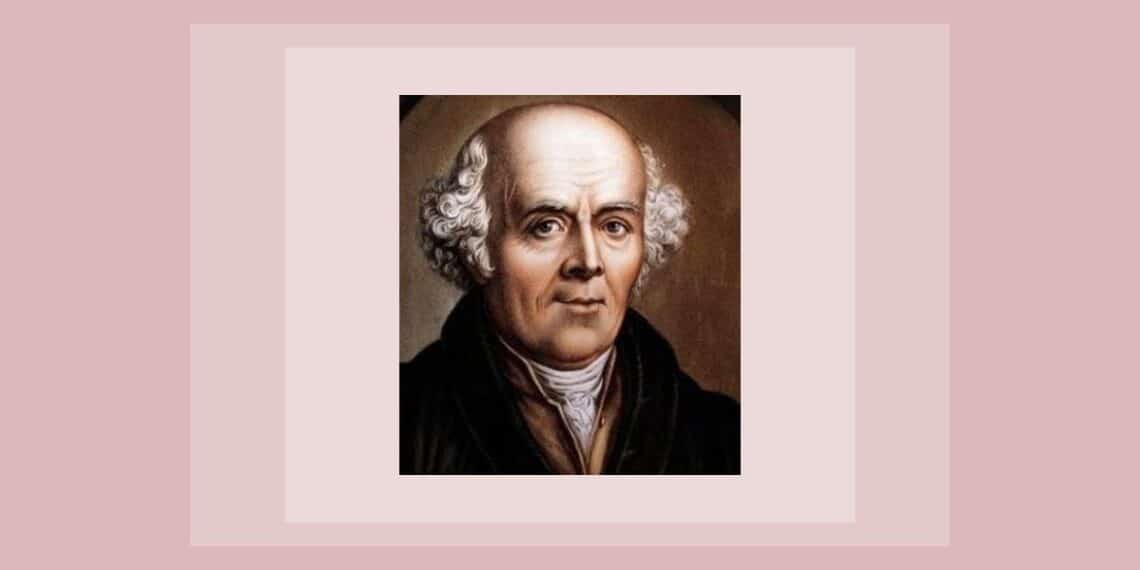

In 1834, a young French woman, Madam Marie Melanie d’Hervilly, impressed with Hahnemann’s writing, came to Koethen to consult him. They developed a deep affection for each other and were subsequently married on January 28th 1835 in Koethen. Hahnemann was eighty at the time and she, less than half his age.
Madam Hahnemann wished to return to Paris, and since Hahnemann had no objection to leaving his own country, they moved at the end of June. Initially they settled in a house situated near the Garden of Luxembourg, but soon moved to a larger one known as Number 1 Rue De Milan’. Hahnemann got his right to practice in Paris with help from Melanie. Dr Hahnemann says in his will that he came to Paris to rest, not to practice, but his practice soon became larger than ever before. His consulting room was so crowded and he was so busy that he did not write any new books. He did revise and publish the sixth edition of the ‘Organon’.
In Paris Hahnemann was well received by homeopathic society. During his time in Paris, many well known people consulted him for their illnesses. The list included chemists, doctors, scientists and royalty from all over Europe. The coaches of his patients were lined up in front of his villa. Hahnemann always examined his patients in the presence of his wife, who never left his side. Melanie mastered his casebooks, lists of symptoms and most obscure notes of Materia Medica Pura.
The world’s greatest violinist, Niccolo Paganini, became Dr. Hahnemann’s patient in 1837. He had to postpone a concert due to “sickness in the trachea”. For many years Paganini had received diverse diagnoses and treatment. Initially he was diagnosed as having syphillis and treated with mercury. Due to the mercury treatment, his all his teeth had fallen out, his mouth had ulcerated and he had abscesses on the jawbone. Paganini also suffered from chronic erection for several years and could ejaculate by the mere sight of women. Due to connective tissue issues, he had hyperextension of his fingers and could play violin very rapidly. He was called the “demon” violinist.
One of the stories about Paganini is that he was a man of great frugality, always bargaining for a lower price. He had a habit of purchasing used clothing and then wearing it and patching it continually. He insisted that “an old garment is an old friend’. It is easy to understand from this, why Dr. Hahnemann prescribed homeopathic Sulphur, a remedy he usually started treatment with. He told Paganini to “take 1 drop of solution already diluted, and mix with 30 spoons of water”. Hahnemann also advised against coffee and tea, and allowed only strongly diluted wine. Dr Hahnemann first gave Sulphur 30 and latter Pulsatilla 30. It turned out that Hahneman was unable to cure Paganini and he soon stopped treating him. There was a break between the two, but for other reasons as well. Paganini had fallen in love with Melanie and told her so. She seems to have responded in a very nasty manner. Dr Hahnemann realized that Paganini had gotten too familiar with his young wife (handley,1990.page114). Following the death of Paganini only three years later, a love letter to Melanie Hahnemann was found among his belongings.
References:
A Homeopathic Love Story – The Story of Samuel and Melanie Hahnemann by Rima Handley
Paganini, the Romantic Virtuoso by Jefferey Pulver
The Homeopathic Revolution by Dana Ullman
Hahnemann Revisited by Luc De Schepper
www.homeoint.org
www.otherhealth.com
www.whonamedit.com